
Summary
What this article covers in 30 seconds
- The research was coordinated by ThoughtLab with support from Recordsure, TCC and major financial services firms.
- Digital access, ESG, democratisation, standards, fees and switching behaviour are reshaping investor expectations.
- Wealth and asset managers need more client-centric segmentation, products, services and pricing models.
- The study surveyed 2,325 investors and 500 advisory and asset management organisations.
Recordsure was part of a wide-ranging research project outlining how wealth and asset management firms will have to adjust to changes in investors’ expectations and priorities following the COVID-19 pandemic.
The Wealth and Asset Management 4.0 group, coordinated by ThoughtLab with support from Recordsure, TCC and a coalition of major financial services firms, released the full findings of an extensive research project into how the pandemic affected the financial industry.
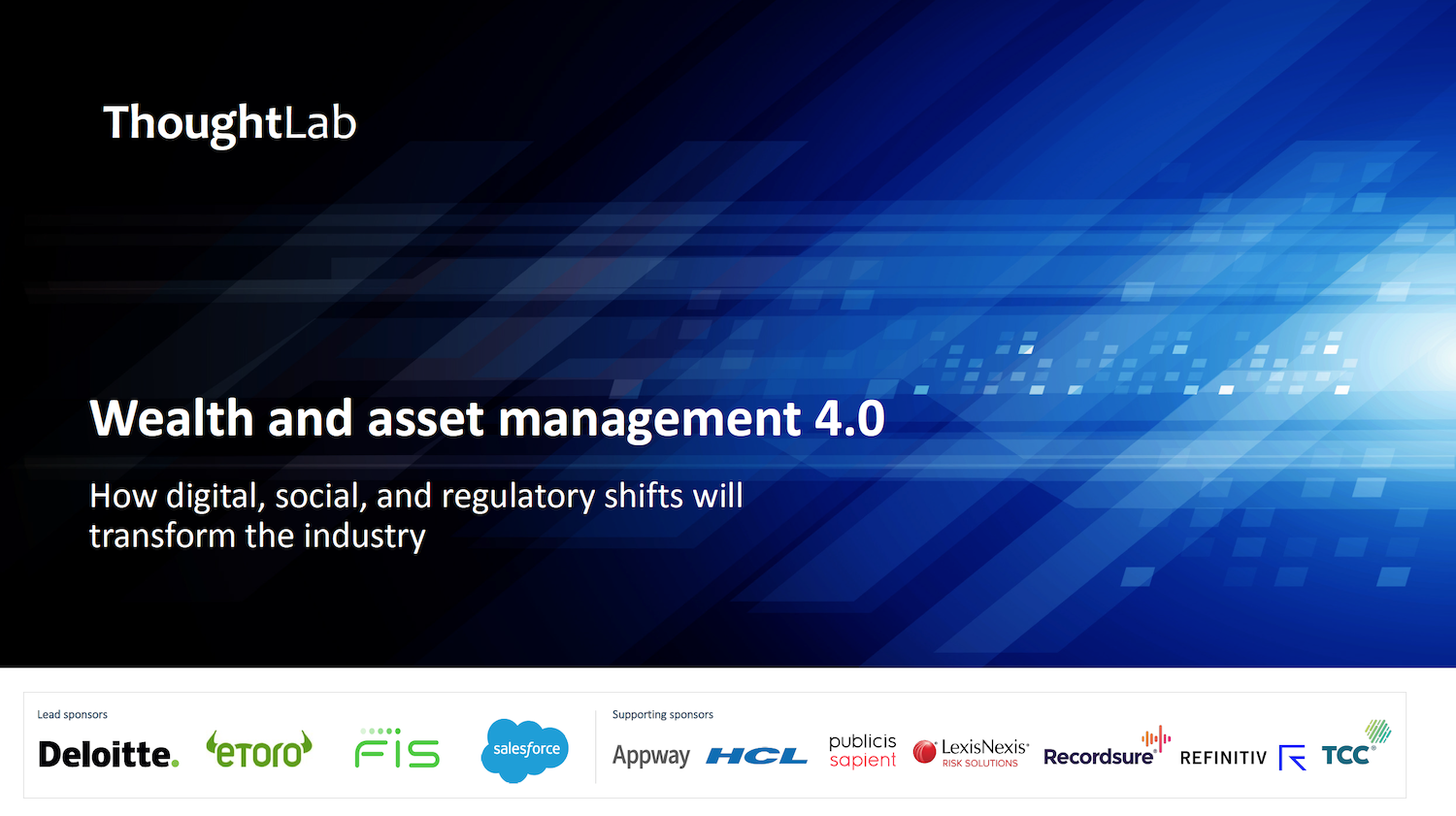
The study, Wealth and asset management 4.0: How digital social, and regulatory shifts will transform the industry, looks at how the pandemic became a watershed moment for the wealth sector.
Recordsure had already seen investors’ attitudes and behaviours evolve towards more socially conscious priorities in response to societal issues such as sustainability and D&I. The findings set out how much the pandemic accelerated that change.
These changes mean wealth and asset management providers need to rethink their strategies, products, services and pricing models to meet the needs and expectations of modern investors.
The future of wealth management: what you need to know
The research outlines a number of crucial shifts that will dictate the course of the industry over the next few years.
- The shift to digital. Because of the pandemic, 40% of investors say digital access has become a greater priority, and nine out of 10 say mobile will be their preferred channel in the future. Digital is no longer just the domain of millennial customers; it is now preferred by older and richer investors.
- Investing with purpose. Over the next two years, 34% of investors will seek ESG investing advice. Investing for social good is no longer limited to millennials: 32% of boomers plan to invest in ESG funds compared with 22% of millennials and 63% of billionaires.
- Democratisation. In two years, 67% of investors will want to invest in alternatives, 49% in IPOs, 47% in tax-exempts and 45% in commodities. Similarly, 58% of investors will want personal financial planning and 53% will want day-to-day financial management services. The difference between wealth levels is fading; for example, 69% of mass affluent investors want to invest in alternatives compared with 65% of VHNW investors.
- Setting higher standards. About half of investors say that acting in their best interests is the most effective way for advisers to build relationships with them. When selecting firms, investors use ESG criteria: 48% consider ethical business practices, 41% vision and integrity, 39% approach to inclusion and 34% social purpose.
- Desire for lower fees and greater transparency. Only 37% of investors are happy with providers’ fees and 36% with fee structures. Even fewer, 35%, understand how their advisers are compensated. Regulators and fintech competition are adding to pricing pressure.
- Investors will switch providers to get what they want. Over the last year, one-third of investors moved 20% or more of their funds to providers that offered what they wanted. Over the next two years, 44% plan to do so. And 62% said they are likely or very likely to leave firms to follow their advisers.
Olivia Fahy, Head of Culture at TCC, said wealth and asset management firms face pressure from investors across generations to provide an ESG offering, with interest spanning generations and demographics.
What this means for wealth and asset managers
To succeed in this marketplace, wealth and asset management firms need a truly client-centric approach, focusing on the person rather than the demographic. That requires reimagining client segmentation, go-to-market strategies, product ranges, services and pricing models.
Providers will need to offer a greater variety of products. Almost two-thirds of providers plan to offer alternatives over the next two years, which is a top requirement for investors, and four out of 10 will offer private placements or venture capital opportunities packaged for a wider range of clients. On the services side, more than half of firms plan to offer goals-based planning and add more ancillary financial-related services.
Firms will also need to integrate digitalisation into business strategies, shifting digital transformation programmes into high gear while finding the right calibration between high-tech and high-touch approaches. The research shows that firms that embrace digital transformation on average increase productivity by 13.8%, AUM by 8.1% and revenue by 7.7%.
Joe Norburn, Group CEO at Recordsure and TCC, said the established wealth and asset management industry has moved through digital change at speed, giving investors a wider range of communications channels to engage with advisers using the methods they are most at ease with.
The insights are based on a global survey of 2,325 investors across age and wealth levels, and a cross-country survey of 500 investment advisory groups, private banks and trust companies, broker-dealers, robo-advisers, family offices, and retail, institutional and alternative asset management firms.
In addition to Recordsure and TCC Group, the study was sponsored by Deloitte, eToro, FIS, Salesforce, Appway, HCL, LexisNexis Risk Solutions, Publicis Sapient and Refinitiv.
Frequently asked questions
The research was coordinated by ThoughtLab with support from Recordsure, TCC and a coalition of major financial services firms.
It identifies shifts towards digital access, purposeful investing, democratisation, higher standards, lower fees, transparency and switching providers.
They need to rethink client segmentation, go-to-market strategies, products, services and pricing models.
The insights were based on a global survey of 2,325 investors and a cross-country survey of 500 investment advisory and asset management organisations.