
Summary
What this article covers in 30 seconds
- Automated redress may cover fewer cases than firms previously expected.
- More complaints may need experienced handlers because unfair-practice issues require nuanced decisions.
- Demand for specialist remediation resource could exceed supply over the next 18 months.
- Policy and procedure readiness can help firms scale faster and support less experienced teams.
Video insight
Resourcing is likely to be one of the largest operational challenges in the upcoming motor finance remediation and redress programme. In part four of the webinar, Mike Morris, Head of Operations at Momenta, explained that the Supreme Court ruling has shifted expectations away from a high-volume automated redress model towards more complex complaint handling.
Firms need to plan for demand, procurement pressure and the risk of many organisations trying to recruit from the same skilled resource pool at the same time.
Garry Evans framed resource as an interesting challenge for the industry and asked how remediation would have looked operationally before the ruling, and what had changed given what the panel had heard.
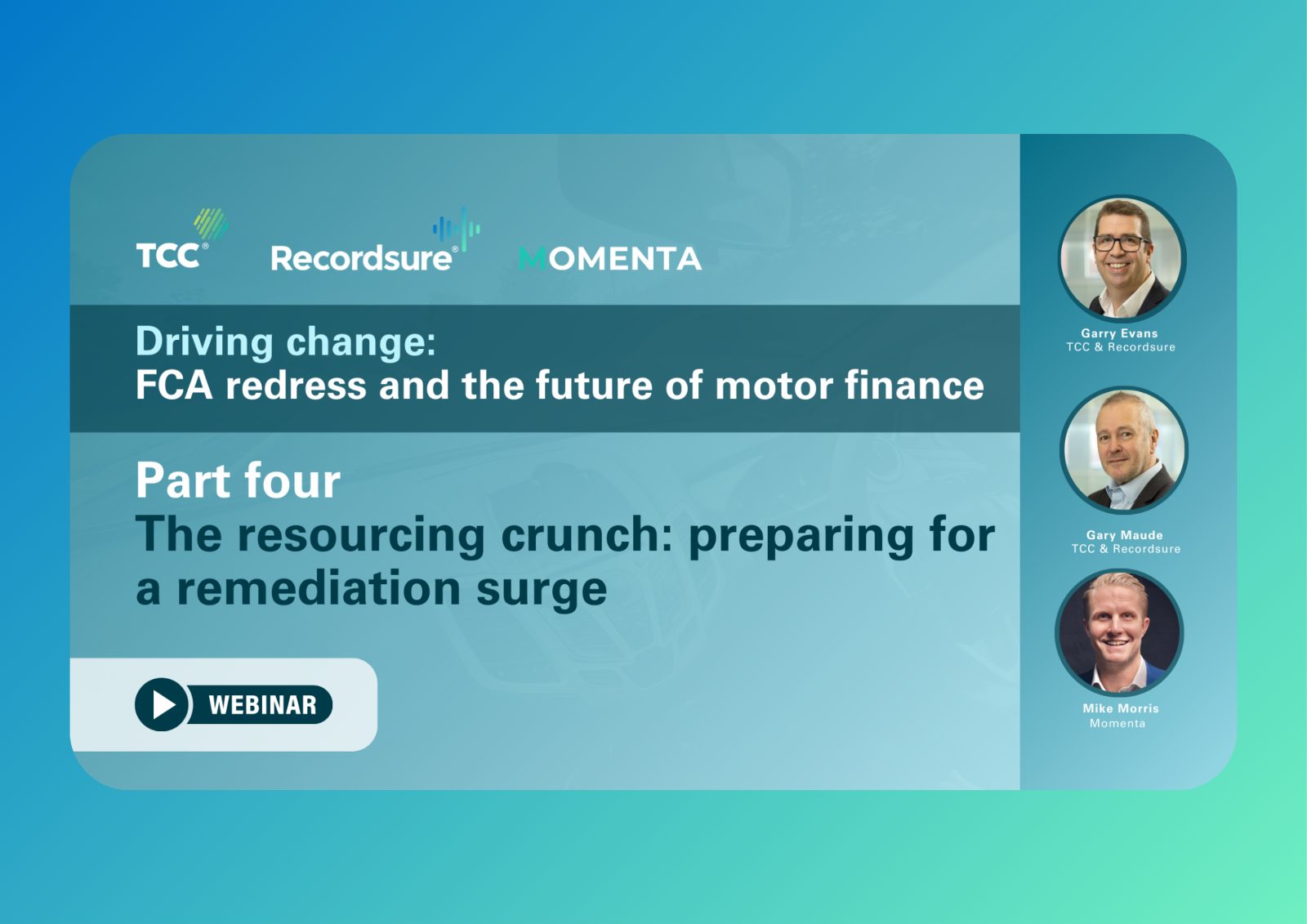
Garry Evans, Chief Product Officer and Chief Commercial Officer for TCC Group, led the webinar with Mike Morris, Head of Operations at Momenta, focusing on the balance between technology-led redress and the realities of delivering remediation across the industry.
How the ruling changes remediation
Before the ruling, the industry expected a redress scheme covering DCA cases and potentially non-DCA cases. Mike Morris said that process could have been relatively straightforward, with technology automating process steps from tracing through to redress and customer contact for perhaps 75-80% or more of the population.
Some cases were always expected to sit outside that automated path. Examples included files with missing customer data, collections activity, vulnerability flags or deceased customers. Those cases would have needed a more tailored process and human review.
The main change is that the volume of cases suitable for automated redress now appears lower. Issues raised around unfair practices may mean a higher volume of complaints falls outside auto redress, and those complaints are likely to be more complex to review.
Mike Morris explained that the earlier expected process would have used workflow technology to move large populations through tracing, redress and customer contact. The exception population would have needed a non-happy-path process for cases where the standard customer file was not enough to support automated treatment.
Why complex complaints need skilled handlers
Complex complaint handling is expected to need more experienced resource. Mike Morris noted that claims management companies are likely to add further complaint points, which firms will need to triage and identify. That creates a more nuanced decision-making process.
The result is a changed cost profile. Payments to customers may be lower than under a wider automated scheme, but the processing cost of remediation could be higher because more cases require skilled human judgement.
Since the ruling on the 3rd, some motor finance creditors have begun procurement exercises before the FCA has provided complete clarity on scope and process. Garry Evans observed that access to the right type of resource may become difficult if many firms try to move at the same time.
He said claims management company behaviour with existing clients and providers suggested additional complaint points would be introduced into cases. Firms would therefore need to identify and triage those points before reaching a decision. That makes the work less mechanical and increases the need for experienced reviewers.
The balance has therefore moved beyond describing a simple automated process. Firms now need to plan for bespoke handling, additional complaint points, missing file data and exceptions that cannot be completed by standard workflow alone.
Readiness and market capacity
The webinar audience was asked what stage of planning they had reached for an expected remediation and redress project. Although the poll had a limited number of respondents, more than half had not started and most of the rest were at the initial preparation stage. Garry Evans said TCC was already seeing RFP activity and clients who had been working on the issue for some time.
Mike Morris explained that entry-level case handlers may be available for more straightforward DCA processes, but unfair-practices work is more specialised. It requires experience in assessing fairness, customer circumstances and details around the sale.
Because all motor finance firms with a back book of affected agreements will be impacted, and many remediation projects are expected over the next 18 months, there may be a shortage of specialist resource. That shortage could affect cost and create delivery risk for some projects.
Garry Evans described procurement activity beginning before the FCA had provided complete clarity on scope and process. His concern was that if firms move at the same time, the right type of resource may be in high demand and difficult to secure.
Mike Morris said the market was fuller for entry-level case handlers who could support more straightforward DCA processing. The potential shortage sits in the more specialised work, where handlers must assess fairness, customer circumstances and sales details.
Delivery organisations may not have separate pools of qualified resources. The Big Four, legal firms with servicing arms, business process outsources, specialist compliance consultancies and professional services businesses may all be fishing in the same associate pool.
The panel expected an 18-month period in which many projects could be running at once. That creates pressures ahead of final FCA detail, particularly where firms are already engaging procurement and trying to understand what resource will be ready.
Preparing to scale delivery
One mitigation is to consider alternative delivery models. Momenta described an offshore solution in South Africa, with experienced resources available to be deployed at a reduced cost.
Another mitigation is early preparation. Firms that have not started can review policies and procedures and assess whether the supporting detail is suitable. Although the final redress scheme is not confirmed, work can be done to bring complaint handling and practices up to date.
Thorough policies and detailed procedures should help businesses scale operations faster. They may also allow firms to use less experienced resource where that resource is supported by clear process guidance.
With more complaints likely to require case-by-case assessment, firms that start preparing now by reviewing policies, tightening procedures and considering alternative delivery models will be better positioned to respond at scale when the FCA finalises its redress scheme. TCC, Recordsure and Momenta can support preparation.
Preparation can start before the scheme detail is confirmed. Firms can examine current complaint practices, understand the suitability of policy detail and make sure procedures are thorough enough to support consistent scaling.
That planning should help firms secure the right skills, design efficient processes and minimise operational risk before the starting gun fires. It also gives businesses a clearer basis for procurement decisions instead of waiting for complete clarity and competing for resource under pressure.
Firms should not wait until demand is at its biggest. Preparing now helps them avoid falling behind other firms and gives them a better chance of having qualified people in place.
Frequently asked questions
More cases may fall outside automated redress because unfair-practice issues require nuanced assessment of complaint points, fairness and customer circumstances.
A workflow system was expected to automate tracing, redress and customer contact for DCA and potentially non-DCA cases.
Many firms may need specialist resource within the next 18 months, creating a shortage that could increase costs and affect delivery.
They can review policies and procedures, improve complaint-handling detail and consider alternative delivery models, including offshore support.