
Summary
What this article covers in 30 seconds
- Ian Ewart has led digital innovation across major financial institutions including Coutts, HSBC and Barclays Wealth.
- Clients now expect more communication channels, so firms need records that work across departments and journeys.
- Firms should explain recording and data use in a constructive way that shows clients the benefit.
- Technology should support human staff by doing heavy lifting and preserving the context of interactions.
How can digitalisation bring new benefits to wealth management firms? Ian Ewart has led digital innovation in financial services and explains why focusing on FinTech and RegTech is vital.
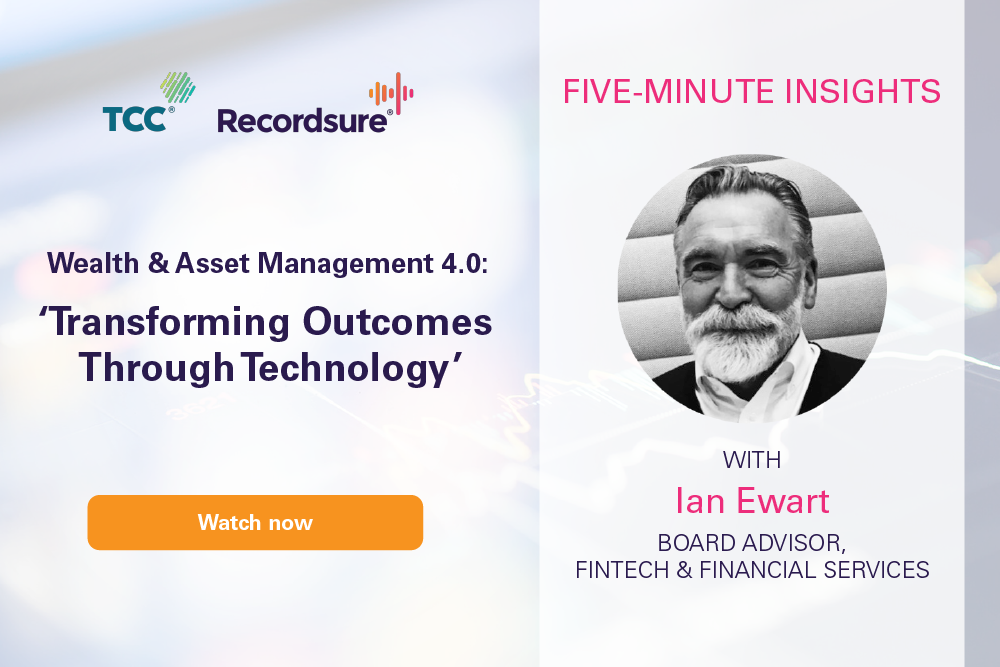
For more than two decades, Ian Ewart has been at the forefront of digital innovation in financial services. Having driven strategy at c-suite level for some of the UK’s largest financial institutions, including Coutts, HSBC and Barclays Wealth, he is well placed to bring clarity to discussions about the future of FinTech and RegTech.
Technology can help businesses serve clients more effectively and make clients and the client journey a strategic priority. Ian joined a recent webinar exploring results from the Wealth and Management 4.0 study and offered practical insights on the survey findings’ implications for firms over the next few years, including how to benefit from the digital era.
Ian’s wider point on culture was that a brand is what people say when the organisation is not in the room. In relation to culture, authenticity is what a firm does when nobody is looking and when the client is not in the room, or setting homework.
Why a client-first approach?
Digital innovation should be judged by how it supports clients. Wealth and asset management firms face permanent changes in expectations following disruption to traditional face-to-face interactions between investors and advisers. New digital platforms mean clients will contact firms through multiple channels.
Firms therefore need records that can sit across departments and channels. This makes communication and information easier to use for the firm and more convenient for clients. The study showed that investors want a wider choice of communication channels, and firms cannot allow those channels to damage the client journey.
Clients need to be made comfortable with digitisation
New technologies create new ways to request, record and store client data. Firms need to give clients the knowledge to navigate that environment with ease.
Every form of engagement should be positioned constructively. Instead of a clinical call-centre message that says, this call may be recorded for training purposes, firms should consider how to explain these systems in a way that shows their benefits to clients.
The investor-adviser relationship is the most valuable asset for wealth management firms. Trust is built on transparency and fair treatment. Clients should understand that the information they share can add value to their journey by helping firms offer better advice and a better customer experience.
Tech should give you ‘superpowers’
Automation and digital engagement create new possibilities, but customers still want service with a human touch. Firms need to ensure their hard-earned brand identity is not lost in translation and that both investors and firms get the best of digital and human service.
The key is to use technology to support staff in day-to-day activity and daily endeavours, giving them technology-enabled ‘superpowers’. Ian said technology has a crucial role to play in doing the heavy lifting and making sure the elements captured at the time remain true, so firms reflect the essence of the moment.
Wealth management firms can use these principles to set themselves up for success in the digital era.
Frequently asked questions
Ian Ewart is a FinTech expert who has led digital innovation in financial services and held senior strategy roles at institutions including Coutts, HSBC and Barclays Wealth.
Clients increasingly contact firms through multiple channels, so communication and information need to be maintained across departments to protect the client journey.
Firms should explain them constructively and show how shared information can support better advice and a better customer experience.
It means technology should do heavy lifting for staff and preserve the context of interactions, while people continue to provide the human touch clients want.