
Summary
What this article covers in 30 seconds
- Technology should enhance, not replace, traditional client-adviser interactions.
- Clients need a frictionless journey if firms want them to provide useful data.
- Culture requires alignment between public commitments, compliance activity and board or regulator reporting.
- ESG should be embedded into strategy, decision-making and everyday conversations across the firm.
Can technology have a positive impact on organisational culture? Emma Parry explores the link between culture, ESG and conduct.
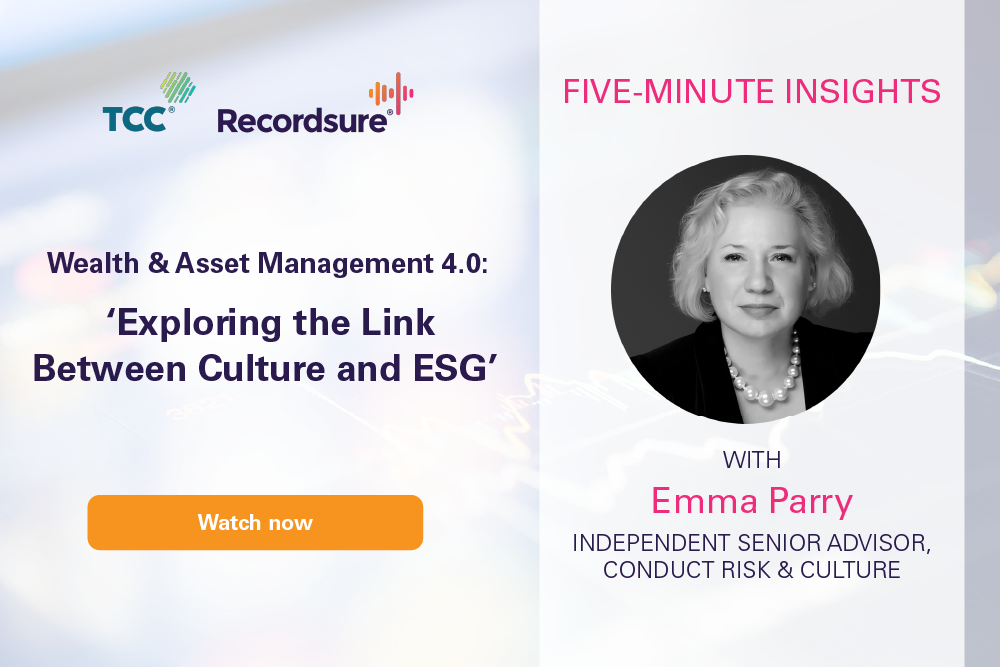
Can technology help drive a positive organisational culture in an age of digitised working and client interactions? Emma Parry, independent senior advisor and conduct risk expert, and Recordsure are exploring the link between culture, ESG and conduct. Emma shares her thoughts on how can digitalisation and RegTech provide financial firms with invaluable tools to manage conduct, compliance and positively impact organisational culture.
Our guest expert, Emma Parry, has 20+ years of experience helping financial institutions strengthen their conduct and culture frameworks. A passionate ambassador for the power of technology in transforming risk management, she is the Founder and CEO of NovaFin Consulting. Emma has previously held senior leadership positions at several major organisations including HSBC and JPMorgan Chase.
We’re thrilled to have had her join the panel of experts during our recent webinar. We examined the findings of Wealth & Management 4.0 study – where Emma gave her top tips for firms looking to realign their culture and compliance strategies for the digital age.
1. Tech should enhance, not replace, traditional client-adviser interactions
While it’s true that digital communication channels offer a wealth of opportunities, inevitably, clients will always want service with a personal touch. And so advisers must resist the temptation to begin cutting corners by relying solely on the demographic data they’re given via apps or online forms.
In fact, they should use their tech-enabled abilities to dig deeper into the clients’ situation – what stage of their life journey are they at? And what are their long-term financial goals? These questions will give you a greater idea of what products will best serve their needs.
But not only that – you’ll also need to offer users a frictionless journey to ensure they give you the best data set possible. After all, if they have to provide the same information again every time they select another method of contact, all that newfound momentum will be lost.
And this is especially important for clients who are more vulnerable or suddenly find themselves vulnerable through circumstance: those who need help are more likely to be open about it if you empower them to communicate in a medium that suits their needs.
2. Aligning words with actions is crucial
It’s no secret that the healthiest company cultures are inclusive, open and purposeful. When it comes to culture, it’s no longer enough to simply mention these guiding principles in your literature – firms need to be walking the walk.
For instance, it’s one thing to promote ESG funds and green bonds. But it’ll soon be picked up on if sufficient due diligence hasn’t been done, or your new offering stands in stark contrast to other areas of your corporate strategy. We know already that Greenwashing is an issue in the industry, and the reputational fall-out can be devasting.
As Emma advises:
Are there any disconnects between what the company is saying and advertising, versus what’s playing out in the media? Companies must ensure alignment and accuracy across marketing, compliance and, critically, what’s being reported to the Board and the regulator. Emma Parry
One of the significant findings of the Wealth and Asset Management 4.0 study is that having a positive social impact is becoming more of a priority amongst clients – both young and old, from mass market consumers to UHNW individuals. And so, whether we’re talking about supporting sustainable investing, or improving diversity and inclusion internally, having an authentic purpose has never been more vital.
3. Effective processes should be second nature
The most effective means of shaping culture is through regular conversations about what your company’s core purpose is in practice. Followed by constructive challenge – and correction, if, for example, processes or behaviours are identified as being ‘off-course’.
Firms should be treating ESG as a fundamental component of their company strategy and decision-making. For Emma, this begins with assessing how desired principles can best map onto a firm’s existing client journey:
Firms should be looking at ESG and thinking: in terms of the products and services they offer, where are the touchpoints between the ‘E’, the ‘S’ and the ‘G’ – and how do they make sure they’re reflected, documented and embedded accordingly. Emma Parry
Of course, for this to be truly effective, everyone has to be on the same page – meaning all employees need to be part of the conversation. That’s why leaders should encourage regular, open discourse among their staff on how to approach ESG day-to-day and, importantly, discuss how ESG relates to the company mission and purpose. Making that strong linkage is critical.
This way, everyone will be invested, actively engaged and know what works and what doesn’t.
To hear Emma’s full breakdown of what a healthy tech-enabled culture looks like, watch our Five-Minute Insights video now:
Frequently asked questions
Emma Parry is an independent senior adviser, conduct risk expert, Founder and CEO of NovaFin Consulting, and former senior leader at HSBC and JPMorgan Chase.
It should enhance personal advice by helping advisers understand the client’s life stage, goals and needs, rather than replacing human interaction.
It uses greenwashing to show the risk when firms’ public ESG commitments are not matched by due diligence or wider corporate strategy.
ESG should be part of strategy, decision-making, client journey design and regular employee conversations about purpose.